

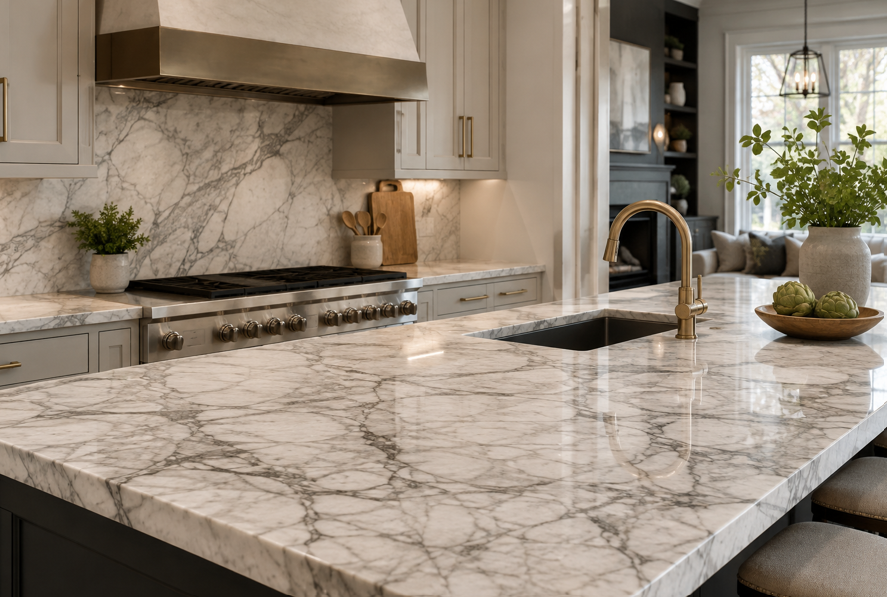
Marble has a way of making a kitchen feel special. Its natural veining, subtle colour variation, and unmistakable depth have kept it at the centre of beautiful interiors for generations. Yet homeowners planning a kitchen renovation in 2026 have more countertop choices than ever, which raises an important question: is marble still worth choosing?
For the right homeowner, absolutely. Marble remains a timeless natural stone with a character that engineered materials cannot fully duplicate. But it also asks more from its owner. It can etch, stain, and develop signs of use, so choosing it successfully means understanding the material rather than expecting a maintenance-free surface.
At Abbott Paint & Carpet, we have been helping St. Paul and Twin Cities homeowners make thoughtful design decisions since 1945. If marble is on your kitchen wish list, this guide will help you weigh its beauty, durability, maintenance, cost, and everyday practicality before deciding whether it belongs in your home.
Are Marble Countertops Still Worth It in 2026? Yes — for the Right Homeowner
Marble is worth considering in 2026 if you value natural beauty, individuality, and a countertop that can develop character over time.
It may be less suitable if your highest priorities are minimal maintenance and keeping the surface looking exactly the same year after year.
That distinction matters because marble is a natural material. Every slab has its own veining, mineral variation, and tonal movement. Even two slabs from the same type of marble can look noticeably different.
For some homeowners, that individuality is exactly the appeal.
Marble also fits naturally with several design directions that remain important in 2026: warm neutrals, natural materials, visible veining, organic texture, and kitchens designed to feel personal rather than perfectly uniform.
A creamy marble with warm veining can soften painted cabinetry and pair beautifully with natural wood. A cooler white-and-grey slab can suit a classic St. Paul kitchen with traditional millwork. More dramatic veining can make an island the visual centre of an otherwise restrained room.
The question, then, is not whether marble is still fashionable.
The better question is whether the way marble looks, performs, and ages matches the way you want to live in your kitchen.
Why Marble Has Remained a Kitchen Classic
Marble has outlasted countless design trends because its appeal comes from the material itself rather than from a manufactured pattern.
The stone is formed naturally, creating veining and movement that cannot be repeated exactly from one slab to another. That variation gives marble a sense of depth that works particularly well across large surfaces such as kitchen islands.
It is also remarkably versatile from a design perspective.
Marble can look at home in:
Traditional kitchens with detailed cabinetry and classic hardware.
Transitional spaces that mix historic character with contemporary updates.
Minimalist kitchens where the countertop provides the main visual interest.
Warm, organic interiors with wood cabinetry and natural finishes.
Statement kitchens built around a dramatic island.
This versatility can be valuable in St. Paul, where homeowners often renovate spaces that already have architectural personality.
A countertop needs to work with the home rather than make the room feel disconnected from it. Marble can complement original trim, warm woodwork, classic cabinetry, and more contemporary renovations without feeling forced into one particular design category.
Marble Makes Every Kitchen Unique
Engineered surfaces can provide impressive consistency. Marble offers almost the opposite.
One slab may have delicate lines running through a soft background. Another may feature bold veins that sweep from one end to the other. Small mineral details, colour shifts, and natural markings make each installation distinctive.
If your goal is a kitchen that feels individual rather than identical to a showroom display, that natural variation can be one of marble's strongest advantages.
Understanding the Main Types of Marble
Not all marble looks the same, and understanding a few of the better-known styles can help you identify what appeals to you.
Carrara Marble
Carrara is known for a generally softer, more restrained appearance. It often combines a pale background with fine grey veining.
Its quieter pattern can work well when you want natural stone without making the countertop the dominant feature in the room.
It pairs especially easily with painted cabinetry, wood finishes, and classic kitchen details.
Calacatta Marble
Calacatta marble is often recognised for more pronounced veining and stronger contrast. Depending on the slab, the veining may include grey, beige, or warm gold tones.
It can work beautifully on a kitchen island because the larger surface gives the stone's movement room to become a design feature.
Other Marble Varieties
Marble is available in a much wider range than white stone with grey veins.
There are warm creams, rich browns, deep greens, dramatic dark marbles, and stones with gold or reddish movement.
This is another reason seeing the actual material is so important. A product name can help narrow the search, but the slab itself tells you what the finished kitchen will really look like.
The Biggest Advantage of Marble: Natural Beauty
If appearance is your highest priority, marble remains difficult to dismiss.
Natural stone has depth, movement, and subtle variation that can change depending on the light. Morning sunlight may highlight one part of the veining, while evening lighting brings out warmer tones elsewhere in the slab.
This can make a marble countertop feel more dynamic than a highly uniform surface.
Marble also works particularly well in kitchens where the materials are intended to age gracefully.
Natural wood cabinetry, unlacquered or warm metal finishes, handmade tile, and marble can all develop visual character over time. Rather than expecting every surface to remain visually untouched, the room becomes more personal as it is used.
That aesthetic is not right for everyone, but for homeowners who appreciate natural materials, it can be extremely rewarding.
The Biggest Consideration: Marble Can Etch
Before falling in love with a marble slab, homeowners need to understand etching.
Marble contains calcium carbonate, which reacts with acidic substances. Common kitchen ingredients such as lemon juice, vinegar, wine, and some cleaning products can therefore affect the finish.
An etch is different from a stain.
A stain occurs when material penetrates the stone and changes its colour. Etching affects the surface finish itself, often leaving a dull or lighter-looking area.
On a highly polished marble countertop, etching can be easier to notice because the affected area reflects light differently from the surrounding stone.
Does Etching Mean Marble Is a Bad Kitchen Surface?
Not necessarily.
It means you need realistic expectations.
Some marble owners become comfortable with small etches and see them as part of the stone's evolving patina. Others prefer a surface that remains visually consistent and find every mark frustrating.
If you know that small imperfections will bother you, that is valuable information before you commit.
A honed finish can also be worth considering because its softer, matte appearance may make minor etching less visually obvious than on a highly polished surface.
Can Marble Countertops Stain?
Marble can absorb liquids, which means staining is another consideration.
Oils, strongly coloured foods, coffee, wine, and other substances can cause problems if they remain on the surface long enough to penetrate the stone.
Sealing can increase the stone's resistance to staining, but an important distinction is that a sealer does not make marble completely stain-proof.
Everyday habits still matter.
A good marble routine includes:
Wiping spills promptly rather than leaving them on the surface.
Using cutting boards during food preparation.
Avoiding acidic household cleaners.
Using appropriate cleaners designed for natural stone.
Following professional advice about sealing the particular marble selected.
Using trivets or protective surfaces where appropriate.
For many homeowners, these habits quickly become routine. For a household where the kitchen regularly experiences spills that remain unnoticed for hours, marble may require more attention than desired.
Marble in a Busy Family Kitchen
A beautiful material still has to work with real life.
Consider how your kitchen is used on an ordinary Tuesday, not only how you want it to look after a renovation.
Do children regularly prepare snacks at the island? Do you cook with citrus, tomato, wine, or vinegar? Do friends gather around the kitchen during weekends? Is your countertop the centre of everything from homework to baking?
None of those activities automatically rules out marble.
They simply help determine whether you are comfortable caring for it.
A homeowner who enjoys natural materials and does not mind signs of use may be delighted with marble in an active kitchen. Someone who wants to put down a glass of lemonade, walk away, and never think about the surface may be happier with an alternative.
Lifestyle fit is more important than following a trend.
Honed vs. Polished Marble: Which Finish Is Better?
The finish you choose can have a significant effect on both appearance and daily experience.
Polished Marble
Polishing gives marble a glossy, reflective surface that highlights colour and veining.
It can create an elegant, formal look and works beautifully when you want the countertop to reflect light and feel refined.
The trade-off is that etch marks can be more noticeable because they interrupt the surrounding sheen.
Honed Marble
Honed marble has a softer, matte or satin-like appearance.
The look is generally more relaxed and works particularly well with warm, natural interiors. Because the surface is already lower in sheen, small etches may blend into the overall finish more easily.
Honed marble can therefore be an appealing option for homeowners who love natural stone but want a less formal, more forgiving appearance.
The right finish depends on the visual effect you want and how you feel about the material changing with use.
Marble vs. Other Popular Countertop Choices
Homeowners rarely consider marble in isolation. Quartz, granite, and quartzite are often part of the same conversation.
Material | Main Appeal | Maintenance | Natural Variation | Best Fit |
|---|---|---|---|---|
Marble | Distinctive veining and timeless natural beauty | Requires attentive care | Very high | Homeowners who value character and accept patina |
Quartz | Consistent appearance and easy everyday care | Generally low | Manufactured pattern | Busy households prioritising convenience |
Quartzite | Natural stone appearance with strong durability | Moderate | High | Homeowners wanting natural stone with a different performance profile |
Granite | Durable natural stone with broad colour options | Moderate | High | Kitchens balancing practicality with natural variation |
There is no universal winner.
Quartz may make more sense for a homeowner whose main goal is uncomplicated maintenance. Quartzite can appeal to someone who wants dramatic natural movement but is comparing performance characteristics. Granite remains a long-standing natural-stone option with its own distinctive patterns.
Marble is strongest when its specific appearance is what you genuinely want.
You can explore Abbott's range of countertops to start comparing materials and visual styles before narrowing your selection.
Does Marble Add Value to a St. Paul Kitchen?
A well-designed kitchen can contribute significantly to how a home feels and how buyers perceive it, but it is better not to choose marble based on the assumption that the material automatically produces a particular financial return.
Its value is more personal than that.
Marble can create an elevated, custom appearance and signal that natural materials were intentionally selected. In the right kitchen, it can become one of the features people remember.
However, good kitchen design depends on the entire space.
A beautiful countertop needs to work with cabinetry, flooring, lighting, hardware, backsplash materials, layout, and the architectural character of the home.
For St. Paul homeowners planning to remain in their homes for years, choosing a countertop they genuinely enjoy living with may be more meaningful than selecting one based entirely on potential resale.
Timeless materials also have an advantage here. Marble has been used in architecture and interiors for centuries, so it does not depend on one particular design moment for its appeal.
What Does Marble Cost?
Marble countertop pricing can vary considerably.
The final cost depends on factors including:
The particular marble selected.
Slab size and availability.
Thickness.
Amount of material required.
Layout and seam placement.
Edge profile.
Sink and cooktop cut-outs.
Fabrication requirements.
Installation complexity.
Some marble may be relatively accessible within the natural-stone category, while rare or especially dramatic slabs can command premium prices.
This is why an estimate based on your actual kitchen is much more useful than relying on a broad online price range.
It is also worth thinking about value beyond the initial material price. If you love the look of real marble and plan to enjoy your kitchen for many years, selecting the surface you truly prefer may be worth the additional care it requires.
On the other hand, paying more for marble makes little sense if you are already worried about every future etch or stain.
7 Questions to Ask Before Choosing Marble
Before making a final decision, use these questions as a reality check.
1. Do I genuinely prefer real marble?
If you keep returning to the depth and movement of natural marble even after seeing alternatives, that tells you something.
2. Am I comfortable with natural variation?
Your countertop will not have a perfectly repeated pattern. Every section of a natural slab is different.
3. How will I react to an etch mark?
If minor changes will feel like damage rather than patina, another material may make you happier long-term.
4. Am I willing to clean spills promptly?
Marble rewards reasonable everyday care.
5. Do I want polished or honed stone?
Think about both appearance and how visible normal wear may be.
6. Does marble fit the rest of my St. Paul home?
Consider cabinetry, flooring, backsplash, lighting, wall colour, and architectural character as one composition.
7. Have I compared actual samples or slabs?
Natural stone deserves to be seen in person. Photographs are useful for inspiration, but they cannot fully show depth, colour variation, or how a slab responds to the lighting in your room.
Who Should Choose Marble Countertops in 2026?
Marble may be an excellent fit if you:
Value natural stone and one-of-a-kind variation.
Want a countertop with timeless design appeal.
Appreciate visible veining and organic movement.
Are comfortable with reasonable ongoing care.
Can accept that the surface may develop a patina.
Want your countertop to become a major design feature.
You may want to consider an alternative if you:
Want the lowest-maintenance surface available.
Expect your countertop to remain visually unchanged.
Know that small etches or marks will bother you.
Have an especially active kitchen and prefer minimal upkeep.
Prefer a highly consistent pattern from one area to another.
Neither decision is wrong.
The goal is to choose a surface you will enjoy living with rather than one that simply looks good in a photograph.
So, Are Marble Countertops Worth It for St. Paul Homeowners?
In 2026, marble remains worth considering precisely because it offers something many other surfaces are designed to imitate: authentic natural variation, depth, and timeless character.
But marble is best chosen with open eyes.
It can etch. It can stain if spills are ignored. Sealing improves stain resistance but does not make the stone maintenance-free. Over time, a well-used marble countertop may develop subtle signs of the meals, gatherings, and everyday routines that happened around it.
For some homeowners, that evolving character is part of its beauty. For others, quartz, quartzite, granite, or another surface may be a better lifestyle match.
If you are planning a kitchen renovation in St. Paul or elsewhere in the Twin Cities, Abbott Paint & Carpet can help you look beyond photographs and compare countertop materials in person. Our experienced design team can help you consider colour, veining, finishes, cabinetry, flooring, and the way your household actually uses the kitchen.
Visit our St. Paul showroom on Grand Avenue or one of our White Bear Lake and Stillwater locations, or get in touch to start finding a countertop that feels right for your home.


