

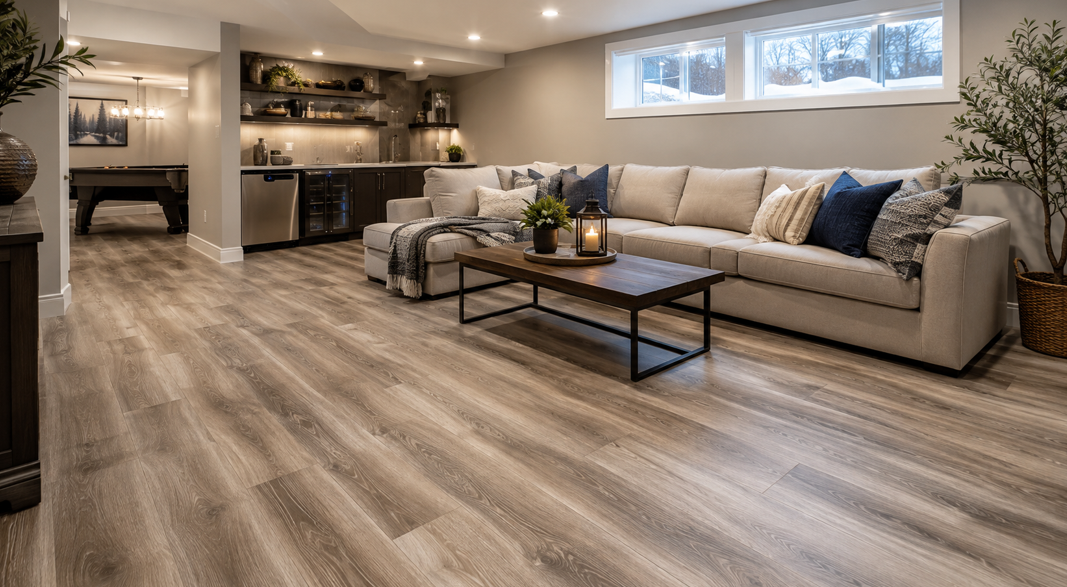
A finished basement can add some of the most useful square footage in a Minnesota home. It can become a comfortable family room, home office, guest space, playroom, home gym, or entertainment area. But before choosing a flooring style based on looks alone, there is one practical issue every Mendota Heights homeowner needs to consider: moisture.
Basements are naturally more vulnerable to moisture than rooms above ground. Concrete slabs, seasonal snowmelt, heavy rain, humidity, plumbing leaks, and changing temperatures can all affect the conditions below your flooring. Choosing the right material can make your finished basement easier to maintain and better suited to everyday family life.
At Abbott Paint & Carpet, we have been helping Twin Cities homeowners choose flooring for their homes since 1945. If you are planning a basement renovation, here is what to know about waterproof flooring and the options worth considering for your Mendota Heights home.
Why Basement Flooring Needs a Different Approach in Minnesota
The flooring that performs beautifully in an upstairs bedroom is not automatically the best choice for a basement.
Most basement floors are installed over concrete, and concrete can interact with moisture in ways that are not always visible from the surface. Water can enter a basement through leaks or seepage, while moisture vapour can move through a concrete slab. Condensation can also develop when warm, humid air comes into contact with cooler basement surfaces.
Minnesota's climate makes these considerations especially important. A basement may experience very different conditions through winter, spring snowmelt, humid summer weather, and periods of heavy rainfall.
That does not mean a Minnesota basement cannot have beautiful finished flooring. It simply means the flooring decision needs to start with the conditions of the space rather than appearance alone.
Before installing a new basement floor, look for warning signs such as:
Damp areas or staining on the concrete.
A persistent musty smell.
Visible mould or mildew.
White, powdery mineral deposits on concrete surfaces.
Previous water intrusion after rain or snowmelt.
Foundation or slab cracks.
Plumbing or sump pump problems.
Areas where the floor remains noticeably damp.
If your basement has an active moisture problem, deal with its source before covering the floor. Waterproof flooring can make everyday spills and occasional surface moisture much easier to manage, but it cannot repair drainage, foundation, plumbing, or seepage problems.
Once the basement is dry and properly prepared, however, there are several excellent flooring choices available.
Luxury Vinyl Plank Is a Top Choice for Finished Minnesota Basements
For many Mendota Heights homeowners, luxury vinyl plank — commonly called LVP — is one of the first basement flooring options worth exploring.
One of LVP's biggest advantages is its combination of moisture performance and realistic design. Many modern luxury vinyl products are designed to be waterproof while recreating the appearance of natural hardwood.
That means you do not have to choose between practicality and a warm, finished look.
Why LVP Works So Well Below Grade
Luxury vinyl plank is particularly appealing for finished basements because it can offer:
Waterproof product construction in qualifying collections.
Easy everyday cleaning.
Durable surfaces for active households.
A wide selection of wood-look designs.
Options ranging from light natural oak to rich brown tones.
Comfortable styling for family-oriented rooms.
A consistent floor across large, open basement layouts.
For a basement that doubles as a family room, play area, office, or entertainment space, those qualities can be especially valuable.
Imagine a lower level with warm wood-look planks flowing from a television area into a home office and children's play zone. The space feels connected and intentional rather than like a separate unfinished level of the house.
LVP and Minnesota Winters
Winter also influences basement flooring decisions. Snow and slush can be tracked indoors on boots, particularly when a lower level has access from a garage, walkout entrance, or mudroom.
A waterproof-rated LVP surface makes these everyday situations easier to manage. Spills and tracked-in moisture can be cleaned promptly without the same concern you might have with materials that readily absorb water.
The important detail is the specific product. Not every vinyl plank is constructed or warranted in exactly the same way, so below-grade suitability, installation requirements, underlayment, and moisture specifications need to be reviewed before making a final choice.
Sheet Vinyl Is Practical, Durable, and Easy to Maintain
Sheet vinyl deserves a closer look for Minnesota basements as well.
Because it is installed in broad sheets rather than individual planks, sheet vinyl can create a surface with fewer seams, depending on the size and shape of the room. That can make it especially useful in basement spaces where easy cleaning and water resistance are priorities.
It can be a practical choice for:
Laundry rooms.
Craft and hobby areas.
Lower-level kitchenettes.
Utility-adjacent spaces.
Children's activity areas.
Multi-purpose basement rooms.
Modern vinyl designs have also come a long way aesthetically. Homeowners can choose from looks inspired by hardwood, stone, and other natural materials, making it possible to create a stylish space without sacrificing practicality.
Preparation Makes a Difference
Sheet vinyl follows the surface underneath it closely, so a smooth and properly prepared subfloor is important.
Cracks, uneven areas, old adhesive, or other imperfections in the concrete can affect the finished result. Taking care of necessary subfloor repairs before installation helps the new floor look better and perform as intended.
This is particularly relevant in older Twin Cities homes, where basement slabs may have experienced years of movement, patching, or previous flooring installations.
Waterproof-Rated Laminate Can Be an Option for a Dry Basement
Laminate has traditionally required more caution in moisture-prone spaces, but newer flooring technologies have expanded the options available to homeowners.
Some modern laminate products are designed with enhanced water resistance, and certain collections may be marketed as waterproof. These products can be worth considering when you want a detailed, realistic wood appearance in a basement that has reliable moisture control.
The key is to pay attention to the exact product specification.
"Water-resistant" and "waterproof" are not interchangeable terms, and performance can differ considerably between products. The manufacturer's guidance for below-grade installation is therefore essential.
Where Laminate May Make Sense
A moisture-rated laminate can be appealing in a reliably dry:
Home office.
Guest room.
Family room.
Reading room.
Hobby space.
Laminate is particularly attractive to homeowners who appreciate detailed wood grain, textured surfaces, bevelled edges, or specific plank designs.
For a basement with a meaningful history of water intrusion, however, a waterproof vinyl option may provide greater peace of mind.
When comparing LVP, vinyl, laminate, and other options, browsing Abbott's full range of flooring can help you narrow your choices before visiting a showroom to see samples in person.
Is Carpet a Good Choice for a Minnesota Basement?
Carpet is not waterproof, so it belongs in a different category from waterproof vinyl flooring. Still, it can have a place in certain finished basements when moisture conditions are well controlled.
Its biggest advantage is comfort.
Minnesota basements can feel cool underfoot, particularly during winter. Carpet adds softness and warmth while also helping absorb sound, which can make it appealing for:
Basement bedrooms.
Home theatres.
Family rooms.
Children's playrooms.
Quiet reading or relaxation areas.
The important condition is that the basement needs to stay reliably dry.
Carpet is generally not a good fit around recurring water sources or in basements with chronic dampness. Water that reaches carpet and padding can be much more difficult to dry than water sitting on a non-absorbent surface.
Consider Combining Flooring Materials
You do not necessarily need one flooring product throughout the entire basement.
A mixed-material plan can be highly practical.
For example, you might use waterproof luxury vinyl through the main basement, near a wet bar, and around a walkout entrance while using carpet in a separate media room or bedroom.
This approach lets you match the flooring to the needs of each space while maintaining a coordinated overall design.
What About Hardwood in a Basement?
Natural hardwood is beautiful, but solid hardwood generally requires greater caution in below-grade installations because wood responds to changes in moisture and humidity.
As moisture levels change, natural wood can expand and contract. In an environment where moisture is difficult to control, that movement may affect the flooring over time.
Engineered hardwood has a different construction and may offer greater dimensional stability than solid hardwood, but suitability still depends on the particular product, installation method, and basement conditions.
If your main goal is the appearance of hardwood, luxury vinyl or suitable laminate can provide convincing wood visuals while offering qualities that may be better aligned with basement use.
Today's wood-look flooring is available in a broad range of styles, from clean contemporary oak to rustic textures and warm traditional tones. That makes it easier to coordinate a practical basement floor with the design of the rest of your Mendota Heights home.
Waterproof Flooring Does Not Waterproof Your Basement
This distinction is one of the most important parts of planning a successful basement renovation.
A waterproof flooring product is designed to resist damage from water according to its particular construction and specifications. It does not prevent water from entering the basement.
If you have ongoing seepage, foundation leaks, poor drainage, plumbing problems, or another significant moisture source, covering the floor will not solve the underlying issue.
Think of basement moisture in three broad categories.
Everyday Spills and Wet Footwear
This is where waterproof flooring can be particularly convenient.
A tipped drink, wet pet paws, snowy boots, or a child's spill can usually be cleaned from an appropriate waterproof surface without creating the same concerns associated with absorbent flooring.
Unexpected Household Leaks
A washing machine, plumbing fixture, water heater, or other household system can occasionally cause water exposure.
Waterproof flooring may help protect the flooring material itself, but water can still reach walls, trim, seams, or areas underneath a floating floor. Prompt clean-up and drying are still important.
Recurring Water Intrusion
If water repeatedly enters the basement through the foundation, slab, windows, drainage system, or another source, solve that issue before finishing the space.
The best new flooring installation starts with a basement that is suitable for finished living space.
How to Choose the Right Waterproof Flooring for Your Basement
Once moisture concerns have been addressed, the next step is matching the flooring to your lifestyle.
1. Think About How You Will Use the Basement
A basement designed as a home gym has different flooring priorities from a guest suite.
For a busy family room, you may value durability and easy cleaning. For an office, appearance may carry more weight. A playroom may need a surface that handles frequent activity, while a walkout basement needs extra consideration for outdoor moisture.
Start with the room's everyday purpose.
2. Consider Children and Pets
Active households often benefit from flooring that is easy to maintain.
Pet bowls, muddy paws, craft projects, children's drinks, and everyday spills are much easier to manage when the flooring is designed for moisture exposure and regular cleaning.
LVP is particularly popular for spaces that need to balance attractive design with practical performance.
3. Look at the Entire Basement, Not One Room
If your lower level has an open layout, consider how the flooring will flow between spaces.
Using one product across connected rooms can visually enlarge the basement and create a cleaner, more cohesive design.
Alternatively, intentionally changing materials can help define separate zones, such as carpet in a television area and vinyl around a kitchenette.
4. Factor in the Existing Concrete
The condition of your slab matters.
Uneven areas, cracks, residual adhesive, or moisture concerns can influence product selection and installation. Subfloor repair and preparation may therefore be an important part of the project rather than an afterthought.
Abbott Paint & Carpet offers flooring installation as well as subfloor repair and project coordination, allowing homeowners to look at the entire project rather than focusing on the flooring material alone.
5. Bring Samples Into Your Home
Basement lighting can change how flooring looks.
A plank that appears light and warm under showroom lighting may look different in a basement with smaller windows or artificial lighting. Seeing samples in your actual space makes it easier to compare colour, texture, furniture, paint, and natural light.
Abbott's shop-at-home sample service can be especially convenient when you want to compare flooring in the room where it will eventually be installed.
Comparing Basement Flooring Options at a Glance
Flooring option | Moisture suitability | Best basement uses | Key consideration |
|---|---|---|---|
Luxury vinyl plank | Excellent when using an appropriate waterproof-rated product | Family rooms, playrooms, offices, open-plan basements | Confirm product and below-grade installation requirements |
Sheet vinyl | Very good for moisture-conscious spaces | Laundry areas, hobby rooms, kitchenettes, multi-purpose spaces | Proper subfloor preparation is important |
Waterproof-rated laminate | Product dependent | Dry offices, guest rooms, family rooms | Check the exact waterproof rating and manufacturer guidance |
Carpet | Best for reliably dry spaces | Bedrooms, theatres, comfortable family areas | Not recommended where recurring moisture is a concern |
Engineered hardwood | Product and conditions dependent | Selected dry finished basements | Confirm below-grade suitability before installation |
There is no single floor that is perfect for every basement. The best choice depends on moisture conditions, how you use the room, the look you want, and the requirements of the individual flooring product.
For many Mendota Heights households, luxury vinyl plank is a strong starting point because it combines waterproof options with versatile wood-look styling. Sheet vinyl is another practical choice, particularly for utility-oriented spaces, while suitable laminate can offer an attractive alternative in a reliably dry basement.
Create a Basement That Is Ready for Real Life
The right basement floor can turn an underused lower level into a space your family genuinely enjoys.
For Minnesota homeowners, the process starts with moisture. Make sure any existing water issues are understood and corrected, evaluate the condition of the concrete, and then choose flooring designed for the conditions and activities your basement will experience.
Waterproof luxury vinyl and sheet vinyl are excellent options to explore, while waterproof-rated laminate may suit certain dry finished spaces. If comfort is the priority and moisture is well controlled, carpet can also play a role in selected rooms.
Most importantly, you do not have to make the decision based on a small online sample or product description.
If you are renovating a basement in Mendota Heights or elsewhere in the Twin Cities, Abbott Paint & Carpet's experienced team can help you compare materials, colours, samples, and installation requirements. Visit one of our St. Paul, White Bear Lake, or Stillwater showrooms, explore options through our shop-at-home service, or get in touch to find flooring that looks beautiful and fits the way you use your home.


